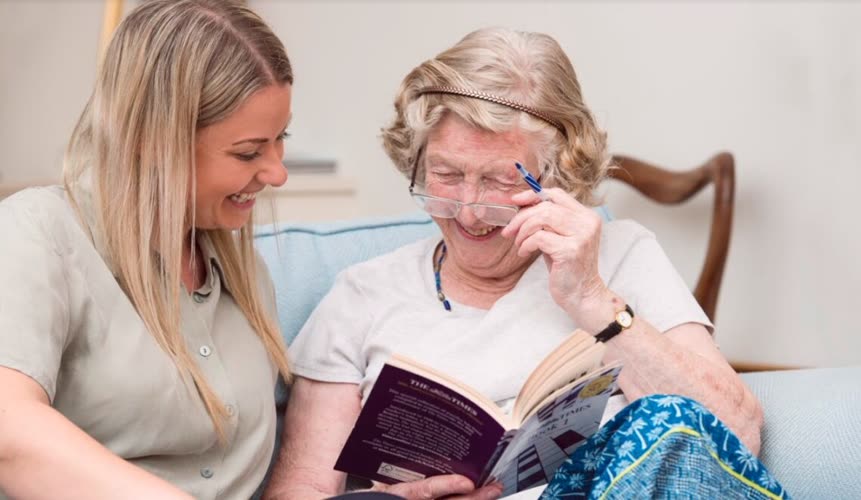
The home stays navigable
Someone with vision loss learns their own home by memory and touch. A live-in carer supports that rather than moving them somewhere unfamiliar and disorientating.
✧ Our services
Sight loss changes how everyday tasks are done, not whether they can be. A live-in carer helps with getting around safely, reading post, cooking and outings, so someone with a visual impairment can stay independent and confident at home.

More than two million people in the UK live with sight loss, according to RNIB, and most of them are older. Common causes in later life include age-related macular degeneration, glaucoma, cataracts and diabetic eye disease. Sight loss can make reading, cooking, managing medication and getting around much harder, and it increases the risk of falls and isolation.
Visual impairment care at home gives the practical support needed to keep living independently. A live-in carer adapts to how the person likes to do things, helps only where needed, and makes going out possible again.
For many older people, sight loss sits alongside hearing loss, diabetes, arthritis or dementia. The combination of dementia and sight loss in particular can cause confusion and misperceptions, and needs a carer who understands both. We match carers with the right experience and brief them on the individual's needs and preferences.
An eye specialist can issue a Certificate of Vision Impairment (CVI), which allows someone to register as sight impaired or severely sight impaired with their council. Registration can open the door to support from the council's sensory team, concessions and some benefits. RNIB's helpline can explain what is available.
Live-in care starts from £1,200 a week. Attendance Allowance or PIP, council support after a needs assessment, and help from the council's sensory impairment team may all be available. See our funding guide.
Small changes at home can make a big difference to safety and independence for people with sight loss:
The council's sensory impairment team and RNIB can advise on equipment and adaptations.
Being guided well makes getting out safer and more relaxed. A trained sighted guide offers their arm rather than taking the person's arm, walks half a step ahead, describes steps, kerbs and obstacles in advance, and explains the surroundings where helpful. Carers use these techniques so the person stays in control and feels confident on walks, in shops and on public transport.
Losing sight later in life can bring grief, frustration, anxiety and isolation, particularly when it means giving up driving, reading or hobbies. Emotional support matters as much as practical help. Carers can help people find new ways to enjoy the things they love — audio books, radio, tactile games, adapted crafts — and keep up social contact. RNIB and local sight loss charities offer emotional support services and groups where people can share experiences.
Some people with significant sight loss experience vivid, silent visual hallucinations, such as patterns, people or animals. This is called Charles Bonnet syndrome. It is caused by the brain responding to reduced visual input, not by mental illness or dementia, and many people are frightened to mention it. Carers who understand it can reassure the person and encourage them to talk to their GP or eye specialist, who can offer advice on managing it.
Taking the right medicine at the right time becomes much harder when labels cannot be read. Mistakes are common and can be dangerous. Practical solutions include asking the pharmacy for large-print labels, using a pharmacy-filled blister pack with each dose in its own compartment, marking bottles with tactile labels or elastic bands, keeping medicines in a consistent place, and using talking reminders on a smart speaker or phone. Eye drops can be especially tricky; some people use a drop guide or have a carer administer them. A live-in carer can check that the right medicines are taken at the right times, while supporting the person to stay as independent as possible.
Technology has transformed daily life for many people with sight loss. Smartphones and tablets have built-in screen readers and magnification; smart speakers can read the news, set reminders, make calls and play audio books by voice; video magnifiers enlarge letters and labels; and apps can read printed text aloud or describe surroundings. Many older people are keen to try these but need help getting started. A carer can set devices up, practise with the person until they are confident, and help them keep in touch with family and friends.
Many councils employ rehabilitation officers for people with visual impairment, who can assess needs and teach skills for daily living and getting around safely, such as using a long cane, cooking safely and managing money. Ask the council's sensory impairment team for an assessment; it is usually free. A carer can then help practise these skills until they become second nature.
Why families choose it
Someone with vision loss learns their own home by memory and touch. A live-in carer supports that rather than moving them somewhere unfamiliar and disorientating.
Post, medication labels, bills and prescriptions all need someone reliable to read them accurately, every time.
A change in carer means learning a new voice, a new way of describing things and a new level of trust. Consistency matters enormously here.
Vision loss often means people stop going out or seeing friends as often. Regular companionship and help getting out helps counter that.
Support is there for what's genuinely difficult or unsafe, while encouraging the person to keep managing what they still can.
Is it right for us?
If one of these sounds familiar, visual impairment care at home is worth a conversation.
Adjusting to a new way of living takes time and support, particularly in the first months after diagnosis.
Poor vision makes trips, missed steps and bumped furniture far more likely, especially in a home that hasn't been adapted.
Reading labels and telling similar packaging apart becomes a real risk without reliable help.
Reading post, managing bills, shopping and appointments takes real time, and family often can't fit it around work and their own lives.
When getting around alone feels unsafe, people understandably stop leaving the house — and loneliness follows.
What a carer does
Every care plan is built from these, weighted to whatever matters most in your household.
Guided support moving around the home and outdoors, keeping familiar surroundings safe rather than a source of risk.
Reading post and labels, managing medication safely, and handling the practical tasks vision loss makes harder.
Regular company and encouragement to keep going out and doing the things that vision loss can make people withdraw from.
Meal preparation, laundry and light housework handled safely, so the home keeps running as it should.
Related services
Live-in care is not one fixed thing. These are the variations families most often need — and we will tell you which one actually fits.
For people who need attention repeatedly through the night. Covers waking nights and, where nights are consistently broken, two carers in rotation.
A professional steps in so a family carer can rest, from a few days to several weeks. Also the easiest way to try live-in care before committing.
For a hospital discharge, a fall, or a carer suddenly unable to continue. We can often have someone in place within 24 to 48 hours.
Cover through the night only, where days are manageable but nights are not. Useful after a hospital stay or while a diagnosis settles.
Carers experienced in memory loss, sundowning and changes in behaviour. Familiar rooms and one consistent face matter more here than anywhere.
Comfort-focused support at home, working alongside district nurses and the GP so symptom control and dignity come first.
Support for the final months, weeks or days at home, for the person and for the family around them.
Where the need is company and daily structure rather than personal care. Often the first step, before anything more is required.
What you get
Being straight about the boundaries saves everyone a difficult conversation later.
Compared honestly
The three realistic options, side by side. We will tell you if one of the others suits you better.
| Live-in care | Residential care home | Visiting care | |
|---|---|---|---|
| Typical weekly cost, one person | From £1,200 | £1,100 – £1,600 | £300 – £900 |
| Typical weekly cost, a couple | From £1,200 (one carer) | £2,200 – £3,200 (two places) | Varies by hours |
| Staff-to-person ratio | One-to-one | Shared across residents | One-to-one, but only during visits |
| Same carer each day | Yes | No — shift rota | Rarely |
| Stay in your own home | Yes | No | Yes |
| Overnight cover | Yes | Yes | No — unless booked separately |
| Couples stay together | Yes | Often not possible | Yes |
| Pets can stay | Yes | Almost never | Yes |
| Visitors any time | Yes | Visiting hours | Yes |
Care home figures are typical UK ranges for 2026 and vary considerably by region and by whether nursing care is included. We quote our own prices exactly; always confirm a care home's fees directly with them.
Our carers
The single biggest worry families raise, and rightly. You choose the carer from matched profiles, and you can speak to them by video call before deciding anything.


Our carers
Our carers are spread across the UK, supported by regional care managers. Every one is interviewed in person, enhanced DBS checked and reference-checked before they are ever introduced to a family — and you choose who moves in.
 Brenda
Live-in carer
Brenda
Live-in carer
 Vistorine
Live-in carer
Vistorine
Live-in carer
 Gladys
Live-in carer
Gladys
Live-in carer
 Monica
Live-in carer
Monica
Live-in carer
 Patience
Live-in carer
Patience
Live-in carer
 Refiloe
Live-in carer
Refiloe
Live-in carer
How it works
A friendly, no-obligation call to understand the situation, explain how the care works and give you an estimated weekly cost.
We send profiles of available carers matched to your needs. You can speak to them on a video call before deciding.
Your carer moves in and support starts, with a named care manager checking in regularly to make sure it's working.
Free callback
Leave your number and a care manager will call you back — usually within an hour, and always free.
Or call us now on 0800 368 8558 Lines open 8am–10pm, seven days a week
Common questions
What families ask us before arranging care.
Not seeing your question?
Our care managers answer these every day. A no-obligation call takes about ten minutes.
0800 368 8558Lines open 8am–10pm, seven days a week See all questionsLive-in visual impairment care starts from £1,200 a week as one fixed weekly fee.
Yes. Carers can guide on walks, at the shops, on public transport and at appointments, so getting out stays possible.
No. The carer helps only where needed and follows your way of doing things, supporting your independence.
Yes. We match carers experienced with both, who understand how the combination affects perception and confidence.
A CVI is issued by an eye specialist and lets you register as sight impaired or severely sight impaired, which can unlock council support and concessions.
Attendance Allowance or PIP depending on age, and support from the council after a needs assessment. RNIB can advise on others.
Improve lighting, use contrasting colours, keep everything in the same place, add tactile markers to appliances, and keep routes clear. The council's sensory team and RNIB can advise on equipment.
Vivid, silent visual hallucinations experienced by some people with significant sight loss. It is caused by the brain responding to reduced vision, not by mental illness. It is worth discussing with a GP or eye specialist.
Offer your arm rather than taking theirs, walk half a step ahead, and describe steps, kerbs and obstacles in advance. This keeps the person in control and confident when out and about.
Yes. RNIB and local sight loss charities offer emotional support, helplines and groups. Carers can also help people find new ways to enjoy hobbies and keep up social contact.
Transparent pricing
One weekly fee covering the agreed care plan. No hidden charges for everyday care.
Read next


Related care
Our elderly care at home service provides one-to-one support at home from a trained, DBS-checked carer — matched to your family's needs, routine and personality.
Almost 3.9 million people in the UK presently live with diabetes. And almost 700 people are diagnosed with same diabetes every day. Since the disease is chronic, the ratio of patients with diabetes is increasing. Since it also increases the risk of developing many associated diseases, diabetes greatly reduces the quality of life of a person.
Our companionship care at home service provides one-to-one support at home from a trained, DBS-checked carer — matched to your family's needs, routine and personality.
Our dementia care at home service provides one-to-one support at home from a trained, DBS-checked carer — matched to your family's needs, routine and personality.
Our private carers service provides one-to-one support at home from a trained, DBS-checked carer — matched to your family's needs, routine and personality.
Near you
Local pages cover how care is regulated and funded where your relative lives.
Where we work
We arrange care in 850+ towns and cities. Choose your area for local pricing, funding and how care is regulated where you live.
Can’t see your area? Call 0800 368 8558 — we almost certainly still cover it.
Free, no-obligation call back
Answer 5 quick questions and one of our care managers will call you back to talk through the options and give you a clear weekly price.
Prefer to talk now? 0800 368 8558 Lines open 8am–10pm, seven days a week
One of our care managers will call you back shortly. If it's urgent, call us now on 0800 368 8558 .