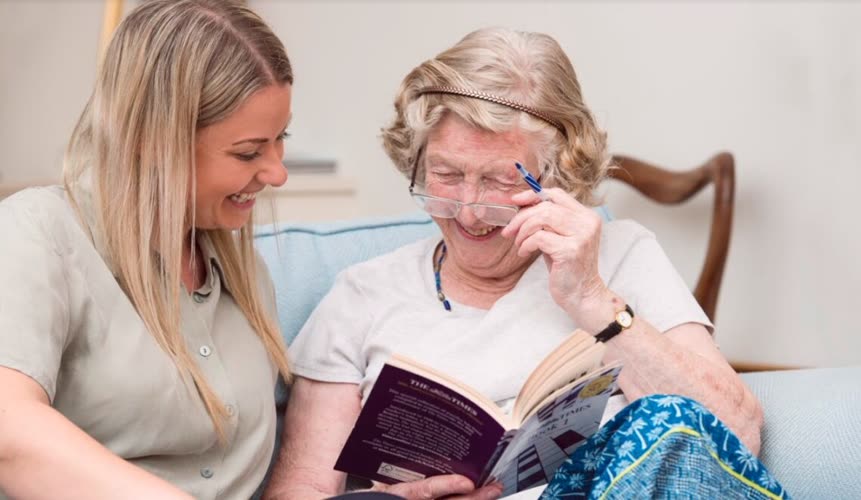
Small changes get noticed early
A carer who's there every day picks up on subtle changes in speech, swallowing or mobility that could signal a problem needing medical attention.
✧ Our services
Recovery from a stroke carries on long after someone leaves hospital. A live-in stroke carer helps with mobility, personal care, rehabilitation exercises and communication, so your relative can rebuild their independence in their own home.

A stroke happens when the blood supply to part of the brain is cut off, either by a clot or by bleeding. Depending on which part of the brain is affected, it can cause weakness on one side of the body, problems with speech and understanding, difficulty swallowing, changes in vision, memory and mood, and extreme tiredness. There are around 100,000 strokes in the UK each year, according to the Stroke Association.
Stroke care at home supports someone through recovery, and through any lasting effects, in their own home. A live-in carer is there throughout the day and night, helping with practical tasks and encouraging the rehabilitation that makes the biggest difference in the months after a stroke.
Many people leave hospital before recovery is complete, sometimes with support from an early supported discharge or community stroke team who visit for therapy. The first weeks at home can be daunting: getting around, washing and dressing may all be harder, and confidence is often low. Having a live-in carer in place for discharge means someone is there from the first night, can collect medication, and can make sure the home is set up safely with any equipment the occupational therapist has recommended.
Most recovery happens in the first months, but many people continue to improve for a year or more, and some live with lasting disability. For them, live-in care provides the ongoing support that lets them stay at home rather than move into a care home: help with personal care and mobility, managing equipment such as hoists, and keeping up a full, social life. A husband or wife who has become a carer overnight can step back and be a partner again.
Live-in stroke care starts from £1,200 a week, or £1,300 where needs are more complex. After a hospital stay, the council may provide a short period of free reablement support, and a needs assessment is free. Attendance Allowance or PIP may be available depending on age, and people with complex health needs after a severe stroke may qualify for NHS Continuing Healthcare. Our guide to stroke recovery and live-in care covers the first months in more detail.
Recovery after a stroke is often fastest in the early weeks and months, which makes the first weeks at home especially important. A realistic picture:
Every stroke is different, and progress is rarely a straight line. A carer who is there every day helps keep momentum going on difficult days.
People who have had a stroke are at higher risk of having another. The stroke team and GP will usually advise on medication and lifestyle to reduce that risk. A live-in carer supports this in practical ways: making sure medicines such as blood thinners and blood pressure tablets are taken correctly, preparing meals lower in salt and saturated fat, encouraging gentle activity, and supporting the person to stop smoking or cut down on alcohol if advised. Everyone in the household should also know the FAST signs of stroke — face drooping, arm weakness, speech problems, time to call 999.
A stroke can change emotions as well as the body. Low mood, anxiety, frustration and sudden, uncontrollable crying or laughing are all common, and can be as hard for families as physical changes. These are symptoms, not character flaws, and they often improve with time and support. Carers are patient, avoid taking outbursts personally, and encourage the person to talk to the GP or stroke team, as treatment and counselling can help. The Stroke Association also offers support for survivors and families.
For many stroke survivors, the real measure of recovery is getting back to the things that matter: a walk to the shop, a meal with friends, a hobby, perhaps driving or work. A carer helps plan and practise these step by step, building confidence rather than doing things for the person. Where lasting disability means some activities are no longer possible, the focus moves to finding new ways to enjoy life at home and in the community.
Many people have swallowing difficulties after a stroke, which can lead to choking, chest infections and poor nutrition. A speech and language therapist assesses swallowing and may recommend softer or modified foods, thickened drinks, particular positions for eating and techniques to swallow safely. It is essential these recommendations are followed exactly, including for snacks and drinks. Carers prepare food and drinks as advised, support the person to eat at their own pace, and report coughing during meals, a wet-sounding voice or chest infections promptly.
Why families choose it
A carer who's there every day picks up on subtle changes in speech, swallowing or mobility that could signal a problem needing medical attention.
Swallowing difficulties after stroke can make eating a choking risk. A carer who understands the person's needs can prepare food safely and help without rushing.
Physiotherapy and speech and language therapy work best when practised daily. A carer can encourage and support those exercises the rest of the week.
Blood pressure medication and anticoagulants need to be taken reliably to reduce the risk of a further stroke. Consistent prompting matters.
Communication difficulties and sudden loss of independence often bring frustration and low mood. Patient, familiar company helps.
Is it right for us?
If one of these sounds familiar, stroke care at home is worth a conversation.
Coming home after a stroke often needs support in place immediately, sometimes with very little notice.
When eating has become a choking risk, families understandably want someone experienced managing it, not guessing.
Washing, dressing and moving around the house become genuinely risky when one side of the body isn't cooperating.
Blood pressure tablets, anticoagulants and other medication need to be taken exactly as prescribed, and families worry about getting it wrong.
Aphasia can make someone withdraw from conversation and company. A patient, familiar carer helps keep them engaged rather than isolated.
What a carer does
Every care plan is built from these, weighted to whatever matters most in your household.
Support with movement affected by one-sided weakness, plus encouragement to keep up prescribed physiotherapy exercises.
Reliable prompting for blood pressure and other medication, and noticing changes that might need a GP's attention.
Patient, unhurried conversation for anyone dealing with speech difficulties after a stroke, and company to reduce isolation.
Meals adapted for swallowing needs, laundry and light housework, so recovery isn't slowed by everyday chores.
Related services
Live-in care is not one fixed thing. These are the variations families most often need — and we will tell you which one actually fits.
For people who need attention repeatedly through the night. Covers waking nights and, where nights are consistently broken, two carers in rotation.
A professional steps in so a family carer can rest, from a few days to several weeks. Also the easiest way to try live-in care before committing.
For a hospital discharge, a fall, or a carer suddenly unable to continue. We can often have someone in place within 24 to 48 hours.
Cover through the night only, where days are manageable but nights are not. Useful after a hospital stay or while a diagnosis settles.
Carers experienced in memory loss, sundowning and changes in behaviour. Familiar rooms and one consistent face matter more here than anywhere.
Comfort-focused support at home, working alongside district nurses and the GP so symptom control and dignity come first.
Support for the final months, weeks or days at home, for the person and for the family around them.
Where the need is company and daily structure rather than personal care. Often the first step, before anything more is required.
What you get
Being straight about the boundaries saves everyone a difficult conversation later.
Compared honestly
The three realistic options, side by side. We will tell you if one of the others suits you better.
| Live-in care | Residential care home | Visiting care | |
|---|---|---|---|
| Typical weekly cost, one person | From £1,200 | £1,100 – £1,600 | £300 – £900 |
| Typical weekly cost, a couple | From £1,200 (one carer) | £2,200 – £3,200 (two places) | Varies by hours |
| Staff-to-person ratio | One-to-one | Shared across residents | One-to-one, but only during visits |
| Same carer each day | Yes | No — shift rota | Rarely |
| Stay in your own home | Yes | No | Yes |
| Overnight cover | Yes | Yes | No — unless booked separately |
| Couples stay together | Yes | Often not possible | Yes |
| Pets can stay | Yes | Almost never | Yes |
| Visitors any time | Yes | Visiting hours | Yes |
Care home figures are typical UK ranges for 2026 and vary considerably by region and by whether nursing care is included. We quote our own prices exactly; always confirm a care home's fees directly with them.
Our carers
The single biggest worry families raise, and rightly. You choose the carer from matched profiles, and you can speak to them by video call before deciding anything.

Our carers
Our carers are spread across the UK, supported by regional care managers. Every one is interviewed in person, enhanced DBS checked and reference-checked before they are ever introduced to a family — and you choose who moves in.
 Vistorine
Live-in carer
Vistorine
Live-in carer
 Gladys
Live-in carer
Gladys
Live-in carer
 Monica
Live-in carer
Monica
Live-in carer
 Brenda
Live-in carer
Brenda
Live-in carer
 Refiloe
Live-in carer
Refiloe
Live-in carer
 Patience
Live-in carer
Patience
Live-in carer
How it works
A friendly, no-obligation call to understand the situation, explain how the care works and give you an estimated weekly cost.
We send profiles of available carers matched to your needs. You can speak to them on a video call before deciding.
Your carer moves in and support starts, with a named care manager checking in regularly to make sure it's working.
Free callback
Leave your number and a care manager will call you back — usually within an hour, and always free.
Or call us now on 0800 368 8558 Lines open 8am–10pm, seven days a week
Common questions
What families ask us before arranging care.
Not seeing your question?
Our care managers answer these every day. A no-obligation call takes about ten minutes.
0800 368 8558Lines open 8am–10pm, seven days a week See all questionsLive-in care can be in place for the day of discharge. We can usually have a carer in the home within 24 to 48 hours of your call, and they can meet your relative from hospital.
Live-in stroke care starts from £1,200 a week, or £1,300 for more complex needs such as significant mobility or swallowing support. It is one fixed weekly fee for the agreed care plan.
Yes. Carers support and encourage the exercises set by physiotherapists, occupational therapists and speech and language therapists, which helps recovery between therapy visits.
Yes. We match carers who are patient communicators and brief them on the approaches recommended by the speech and language therapist, including communication aids.
Either. Some families need a few weeks of support while their relative regains independence; others need ongoing care after a more severe stroke. The same carer can continue as needs change.
Short-term reablement may be free after discharge. A council needs assessment, Attendance Allowance or PIP, and NHS Continuing Healthcare for complex health needs are all worth checking.
It varies widely. Many people make their biggest gains in the first months, and improvement can continue for a year or more. Some live with lasting effects and need ongoing support.
Face drooping, Arm weakness, Speech problems and Time to call 999. Anyone showing these signs needs emergency help straight away, even if the symptoms seem to pass.
Yes. Low mood, anxiety and emotional changes are common after a stroke. They should be discussed with the GP or stroke team, as treatment and support can help.
Yes. Carers help plan and practise everyday activities and hobbies step by step, adapting them where needed, for example one-handed gardening or large-print puzzles, so confidence and independence grow rather than the carer doing things for the person.
Transparent pricing
One weekly fee covering the agreed care plan. No hidden charges for everyday care.
Read next


Related care
Brain injuries can be acquired brain injuries or traumatic brain injuries. Acquired brain injuries (ABIs) are caused by stroke or brain tumor, while a traumatic brain injury (TBI) results from physical trauma. Either way, the patient needs live-in care that specializes in brain injury, especially if the disability is life-long. The worst form of body damage that could happen is an injury to the brain. Head injuries are the leading cause of disability and death in adults. Brain injuries acquired or traumatic result in brain tissue damage and hence swelling of the tissue. Since the skull cannot accommodate by increasing in size, there is a buildup of pressure in the brain.
There are two types of nervous systems, the central nervous system, and the peripheral nervous system. The central nervous system is composed of the brain and spinal cord, and the peripheral nervous system is composed of nerves that branch out of the spinal cord and extend to the other body parts.
When an elderly individual is admitted into the hospital for treatment, it can be a very difficult time. They will have to deal with the stress of being in hospital and there may also be other medical issues that they are dealing with at the same time. The process of recovery can take a long time, which means that you need to find ways to provide them with care whilst they are in hospital - whether this is through using visiting services or by providing them with Elderly care UK.
The lifestyle, which includes diet and exercise patterns, plays the most important role in developing, deteriorating, and treating the disease. You may feel like it is easy to manage it all by yourself, but in fact, it is not.
Live-in Care Direct offers you trustworthy and professional staff to rely on with your aged family member instead of sending them away to care homes. Poor mobility and frailty that comes with advancing age can be dealt with perfectly in the comfort of one’s home with live-in care , while staying close to the loved ones.
Near you
Local pages cover how care is regulated and funded where your relative lives.
Where we work
We arrange care in 850+ towns and cities. Choose your area for local pricing, funding and how care is regulated where you live.
Can’t see your area? Call 0800 368 8558 — we almost certainly still cover it.
Free, no-obligation call back
Answer 5 quick questions and one of our care managers will call you back to talk through the options and give you a clear weekly price.
Prefer to talk now? 0800 368 8558 Lines open 8am–10pm, seven days a week
One of our care managers will call you back shortly. If it's urgent, call us now on 0800 368 8558 .