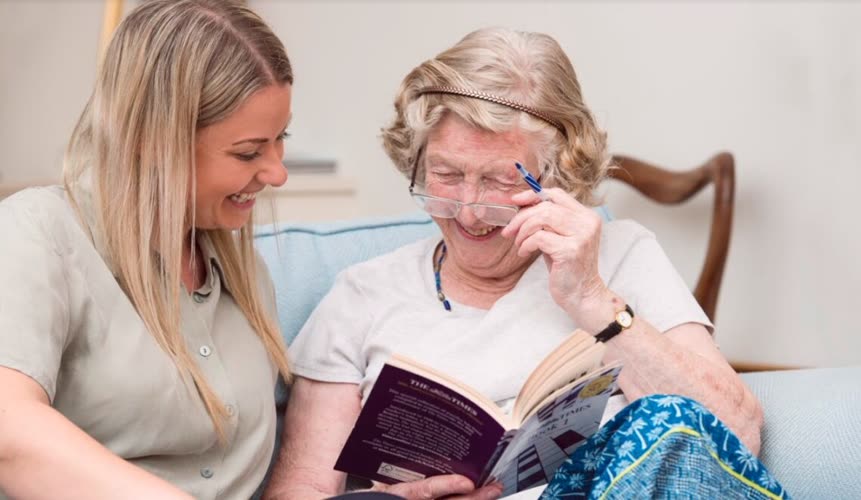
One carer, not a rota
The same person every day. They learn the routine, notice when something is off, and act before it becomes an emergency.
✧ Our services
Live-in care means a trained carer moves into your loved one's home and supports them one-to-one, day and night. It is the main alternative to a care home: the person stays in their own home, with their routine, their partner and their pets.

Live-in care is a form of home care in which a professional carer lives in the home of the person they support. The carer has their own bedroom, provides help through the day, and is in the house overnight. It is one-to-one care: one carer for one person, or for a couple, rather than staff shared between many residents in a care home or a series of short visits from different visiting carers.
Families usually consider live-in care when someone can no longer manage safely on their own, and the choice seems to be between a care home and "carrying on as we are". Live-in care is the third option: the right amount of help, at home.
A live-in carer's role is shaped around the person, but typically includes:
Live-in carers do not carry out clinical nursing tasks such as injections or complex wound care; district nurses continue to visit for those. See what a live-in carer does for more detail.
The carer works to a care plan agreed with you before they arrive. They need a private bedroom, access to a bathroom and, ideally, Wi-Fi. They take a two-hour break each day, when family or another carer can cover if needed, and get a proper night's sleep. Carers usually work for a period of weeks and then have time off, when a relief carer who knows the routine takes over. If the person needs help regularly through the night, two carers share the care so someone is always awake. Our guide to carer changeover day explains how handovers work.
Live-in care suits people who need more help than a few visits a day can give, or who should not be alone overnight, including people living with dementia, Parkinson's, after a stroke, with frailty and falls, or at the end of life. It is also a popular choice for couples, who can stay together with one carer supporting both, and for people coming home from hospital who need help for a few weeks.
Both have their place. The main differences families weigh up are one-to-one care rather than shared staff; the same familiar carer rather than changing shifts; staying at home with a partner, pets and neighbours; and visitors any time. For one person, live-in care costs from £1,200 a week, comparable to many residential care homes; for a couple it is usually much less than two care home places. Read live-in care vs a care home for a full comparison.
Our live-in care starts from £1,200 a week for standard support, £1,300 a week for specialist needs such as dementia or regular night-time help, and £2,600 a week when two carers are needed. It is one fixed weekly fee covering the agreed care plan, not an hourly rate, and the price is the same wherever you live in the UK. Help may be available through Attendance Allowance, the council, or NHS Continuing Healthcare. See pricing and funding.
There are two main models. A managed service employs carers and is registered with the regulator for the care it provides. An introductory agency, like Live-in Care Direct, finds, vets and introduces self-employed carers, and the family agrees the arrangement directly with the carer, usually at a lower cost and with more choice over who provides the care. Our page on introductory agency status explains exactly what that means for you. Whichever you choose, ask how carers are vetted, how cover works during breaks, and what happens if a carer is not the right fit.
Families often ask what the first days actually look like. Broadly:
We check in during the first week. If something is not working, the earlier we hear about it, the easier it is to put right.
Live-in care is one of the few options that lets a couple stay together when one or both need support. One carer can often support both partners, even when their needs differ — for example one living with dementia and the other with limited mobility. Compared with two care home places, the saving can be considerable. Our guide to live-in care for couples explains how it works and when two carers are needed.
The most common reflection from families is simply: "We should have done this earlier." Many wait until a fall, a hospital admission or a carer's breakdown forces a decision, and then have to arrange everything in days. Arranging live-in care while the person can still take part in choosing their carer and shaping their routine tends to make the transition smoother and the arrangement more successful. If you are unsure whether it is time, a no-obligation conversation costs nothing and often clarifies things.
Why families choose it
The same person every day. They learn the routine, notice when something is off, and act before it becomes an emergency.
No packing up a life into one room. Own bed, own kitchen, own garden, own chair by the window — and the pet stays too.
One carer can support two people under a single weekly fee. Care homes charge for two places and often cannot take couples at all.
A residential home shares staff across a floor. A live-in carer is there for one household, which is a different quality of attention entirely.
No visiting hours, no signing in. Family and friends come and go as they always did.
Familiar surroundings plus someone present around the clock is the combination that keeps people out of hospital.
Is it right for us?
If one of these sounds familiar, live-in care at home is worth a conversation.
The most common reason families call us. Live-in care delivers the same round-the-clock cover without the move.
When 30-minute visits stop covering the need, or a different face turns up each day, live-in care is usually the next step.
Discharge often comes at short notice. We can frequently have a carer in place within 24 to 48 hours.
Familiar rooms and a consistent carer matter enormously when memory is failing. Moving somewhere new rarely helps.
Whether for a fortnight or permanently, handing over to a professional is not giving up. It is usually overdue.
Distance makes daily oversight impossible. A named care manager and one consistent carer close that gap.
What a carer does
Every care plan is built from these, weighted to whatever matters most in your household.
Washing, bathing, dressing and grooming — help given with dignity, at the pace the person sets.
Specialist support for dementia, Parkinson’s, MS, stroke recovery and other medical needs, alongside district nurses.
Conversation, company at mealtimes and activities that actually interest them — the part that prevents decline.
Light cleaning, laundry, meal preparation and the weekly shop, so the home runs as it always did.
Related services
Live-in care is not one fixed thing. These are the variations families most often need — and we will tell you which one actually fits.
For people who need attention repeatedly through the night. Covers waking nights and, where nights are consistently broken, two carers in rotation.
A professional steps in so a family carer can rest, from a few days to several weeks. Also the easiest way to try live-in care before committing.
For a hospital discharge, a fall, or a carer suddenly unable to continue. We can often have someone in place within 24 to 48 hours.
Cover through the night only, where days are manageable but nights are not. Useful after a hospital stay or while a diagnosis settles.
Carers experienced in memory loss, sundowning and changes in behaviour. Familiar rooms and one consistent face matter more here than anywhere.
Comfort-focused support at home, working alongside district nurses and the GP so symptom control and dignity come first.
Support for the final months, weeks or days at home, for the person and for the family around them.
Where the need is company and daily structure rather than personal care. Often the first step, before anything more is required.
A typical day
There is no fixed schedule — that is rather the point. This is the shape most days take.
Up at whatever time suits — not a fixed institutional schedule. Help with washing and dressing, medication, and breakfast made the way it has always been made.
Out to the shops, a coffee, the hairdresser or a hospital appointment. Or the garden, the crossword and the radio if that is the preference.
Lunch, a rest, visitors, a walk with the dog. The carer handles laundry and housework around whatever else is happening.
Dinner together, television, a phone call to family. Evening medication and help getting ready for bed.
The carer sleeps in their own room and is there if needed. Where nights are regularly broken we would recommend waking-night cover or a second carer.
What you get
Being straight about the boundaries saves everyone a difficult conversation later.
Compared honestly
The three realistic options, side by side. We will tell you if one of the others suits you better.
| Live-in care | Residential care home | Visiting care | |
|---|---|---|---|
| Typical weekly cost, one person | From £1,200 | £1,100 – £1,600 | £300 – £900 |
| Typical weekly cost, a couple | From £1,200 (one carer) | £2,200 – £3,200 (two places) | Varies by hours |
| Staff-to-person ratio | One-to-one | Shared across residents | One-to-one, but only during visits |
| Same carer each day | Yes | No — shift rota | Rarely |
| Stay in your own home | Yes | No | Yes |
| Overnight cover | Yes | Yes | No — unless booked separately |
| Couples stay together | Yes | Often not possible | Yes |
| Pets can stay | Yes | Almost never | Yes |
| Visitors any time | Yes | Visiting hours | Yes |
Care home figures are typical UK ranges for 2026 and vary considerably by region and by whether nursing care is included. We quote our own prices exactly; always confirm a care home's fees directly with them.
Our carers
The single biggest worry families raise, and rightly. You choose the carer from matched profiles, and you can speak to them by video call before deciding anything.


Our carers
Our carers are spread across the UK, supported by regional care managers. Every one is interviewed in person, enhanced DBS checked and reference-checked before they are ever introduced to a family — and you choose who moves in.
 Gladys
Live-in carer
Gladys
Live-in carer
 Refiloe
Live-in carer
Refiloe
Live-in carer
 Patience
Live-in carer
Patience
Live-in carer
 Brenda
Live-in carer
Brenda
Live-in carer
 Monica
Live-in carer
Monica
Live-in carer
 Vistorine
Live-in carer
Vistorine
Live-in carer
How it works
A friendly, no-obligation call to understand the situation, explain how the care works and give you an estimated weekly cost.
We send profiles of available carers matched to your needs. You can speak to them on a video call before deciding.
Your carer moves in and support starts, with a named care manager checking in regularly to make sure it's working.
Free callback
Leave your number and a care manager will call you back — usually within an hour, and always free.
Or call us now on 0800 368 8558 Lines open 8am–10pm, seven days a week
Common questions
What families ask us before arranging care.
Not seeing your question?
Our care managers answer these every day. A no-obligation call takes about ten minutes.
0800 368 8558Lines open 8am–10pm, seven days a week See all questionsOur live-in care starts from £1,200 a week, £1,300 for specialist needs such as dementia, and £2,600 when two carers are needed. It is one fixed weekly fee for the agreed care plan, the same anywhere in the UK.
With live-in care, one carer lives in and sleeps at night. With 24 hour waking care, two carers share the care so someone is always awake. Both mean the person is never alone.
Yes. A live-in carer needs a private bedroom with a bed and storage, access to a bathroom and ideally Wi-Fi. They also need a two-hour break each day.
For one person it is often comparable to a residential care home and usually less than nursing care. For a couple it is typically much cheaper, because one carer can support both.
Most arrangements are in place within a week. In an emergency, such as a hospital discharge, we can usually have a carer in the home within 24 to 48 hours.
Yes. We send profiles of matched, available carers and you choose, with a video call first if you would like. Every carer is interviewed in person and enhanced DBS checked.
Tell us. It is normal for the first match not to be perfect, and there is no need to put up with an arrangement that is not working. We will talk it through and introduce a better-suited carer.
Usually the household provides everyday meals for the carer, as they live in and share the kitchen. Some families agree a food allowance instead. We explain the arrangement clearly before care starts.
Many can. They may use the family car if insured to drive it, or help with taxis and public transport. Tell us if driving is important so we can match accordingly.
There is no long-term contract. Short-term care usually starts from two weeks, and ongoing care can be adjusted or ended with notice as your needs change.
Transparent pricing
One weekly fee covering the agreed care plan. No hidden charges for everyday care.
Read next


Related care
24 hour live-in care means someone is in the home around the clock — including through the night, when help is most often needed and least often available.
Our dementia care at home service provides one-to-one support at home from a trained, DBS-checked carer — matched to your family's needs, routine and personality.
Our elderly care at home service provides one-to-one support at home from a trained, DBS-checked carer — matched to your family's needs, routine and personality.
Our respite care at home service provides one-to-one support at home from a trained, DBS-checked carer — matched to your family's needs, routine and personality.
Our companionship care at home service provides one-to-one support at home from a trained, DBS-checked carer — matched to your family's needs, routine and personality.
Near you
Local pages cover how care is regulated and funded where your relative lives.
Where we work
We arrange care in 850+ towns and cities. Choose your area for local pricing, funding and how care is regulated where you live.
Can’t see your area? Call 0800 368 8558 — we almost certainly still cover it.
Free, no-obligation call back
Answer 5 quick questions and one of our care managers will call you back to talk through the options and give you a clear weekly price.
Prefer to talk now? 0800 368 8558 Lines open 8am–10pm, seven days a week
One of our care managers will call you back shortly. If it's urgent, call us now on 0800 368 8558 .