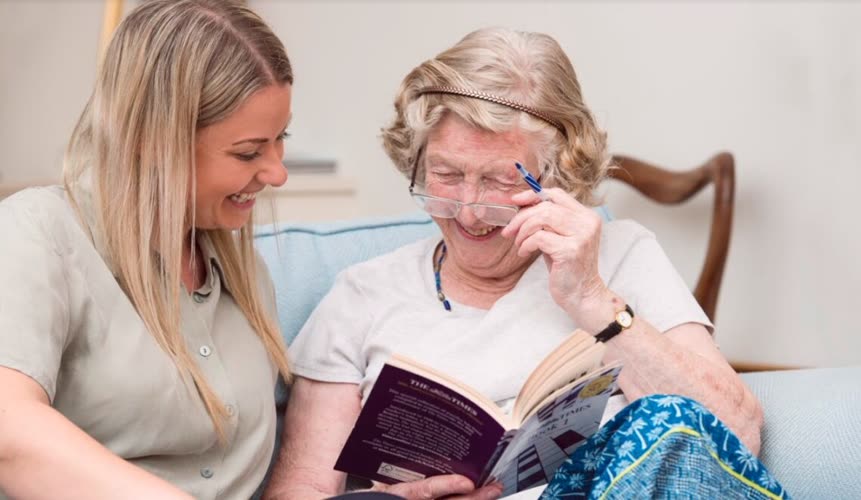
Confusion is reduced, not increased
Staying among familiar furniture, photos and routines matters enormously once memory starts to fail — a new environment, even a nice one, often makes disorientation worse.
✧ Our services
Alzheimer's disease is the most common cause of dementia. Live-in Alzheimer's care gives your relative one experienced carer at home who understands memory loss, keeps routines steady and adapts as the disease progresses.

Alzheimer's care is support for someone living with Alzheimer's disease, a progressive condition in which changes in the brain gradually affect memory, thinking, language and, over time, everyday abilities. It is the most common cause of dementia in the UK. Live-in Alzheimer's care brings that support into the home: one carer lives with the person, helping them manage daily life, stay safe and keep doing the things that give their day meaning.
Alzheimer's usually develops slowly, over several years, and every person's path is different. Broadly, families see three phases:
A live-in carer adjusts as these changes happen, so your relative does not need to move or meet a new team each time their needs increase.
Changes in behaviour are often the hardest part for families: agitation in the evening, repeated questions, accusations of theft when something has been misplaced, or distress at bathtime. These are usually a response to confusion, pain, tiredness or fear rather than deliberate. An experienced carer looks for the cause, stays calm, and uses distraction and reassurance rather than argument. Over time they learn the triggers and how to avoid them, which is something rotating visiting carers rarely have the chance to do.
Often it is a husband or wife who has been providing care, sometimes for years, before asking for help. Live-in care lets the couple stay together at home, with one carer supporting the person with Alzheimer's and taking the strain off their partner, for a single weekly fee. Families tell us the biggest change is that the healthy partner can go back to being a husband or wife rather than a full-time carer.
Live-in Alzheimer's care starts from £1,300 a week. Many people with Alzheimer's qualify for Attendance Allowance, which is not means-tested, and a council needs assessment is free. In the later stages, people with complex health needs may qualify for NHS Continuing Healthcare. Our funding guide explains each route, and setting up a lasting power of attorney early is strongly recommended.
People with Alzheimer's often lose the ability to start activities long before they lose the ability to enjoy them. Boredom and a lack of purpose can show up as restlessness, repetitive questions or low mood. A good carer finds activities that match the person's history and current abilities:
The aim is enjoyment and a sense of usefulness, not the right answer.
Some people with Alzheimer's are prescribed medicines that can help with symptoms for a time, such as cholinesterase inhibitors or memantine, alongside medicines for other conditions. Managing several tablets at different times is exactly the sort of task memory loss makes difficult. A live-in carer makes sure medicines are taken as prescribed, notices side effects such as nausea, dizziness or sleep changes, and reports them to the GP or memory service. Any changes to treatment are always decided by the prescriber.
Weight loss and dehydration are common as Alzheimer's progresses. People may forget to eat, not recognise hunger or thirst, struggle with cutlery or find busy plates confusing. Carers help by offering regular small meals and snacks, using plain plates that contrast with the food, providing finger foods when cutlery becomes difficult, sitting and eating together, and keeping drinks visible and within reach. Later on, if swallowing becomes difficult, a speech and language therapist can advise on safe textures.
Thinking ahead about the later stages of Alzheimer's can be painful, but it means decisions are made calmly rather than in a crisis. Useful steps include an advance care plan recording the person's wishes, a conversation with the GP about a ReSPECT form, checking eligibility for NHS Continuing Healthcare as needs grow, and planning equipment such as a profiling bed. With live-in care and community nursing support, many people with advanced Alzheimer's are cared for at home until the end of their lives.
Appointments with the GP, memory clinic, dentist or hospital can be stressful and confusing for someone with Alzheimer's, and they may not be able to explain their symptoms or remember what was said. A carer who knows the person well can go with them, help them feel calm, give the clinician an accurate picture of how they have been, and remember the advice given. Taking a list of questions, current medicines and any recent changes helps make the most of the appointment, and many surgeries can offer longer appointments if asked.
Why families choose it
Staying among familiar furniture, photos and routines matters enormously once memory starts to fail — a new environment, even a nice one, often makes disorientation worse.
The same carer every day is far easier for someone with Alzheimer's to accept than a changing shift of unfamiliar staff, which can itself trigger distress and agitation.
Evenings are often the hardest part of the day. A carer who knows the person's pattern can settle agitation before it escalates, rather than reacting to it cold.
A consistent carer spots a drop in appetite, a new stumble, or a change in speech far sooner than a rota of different visitors would.
Handing over the physical and emotional load of day-to-day care means visits can go back to being about connection, not managing a crisis.
Is it right for us?
If one of these sounds familiar, Alzheimer's care at home is worth a conversation.
A relative has been found outside, or tried to leave the house at night. Round-the-clock supervision without locking someone in is usually the reason families call.
Families often want to plan ahead rather than wait for a crisis, arranging support gradually so it grows alongside the condition.
Missed tablets, doubled-up doses, or unpaid bills are frequently the first sign that daily supervision, not just occasional visits, is needed.
Constant vigilance for wandering, agitation or falls is exhausting. Handing this over is not giving up — it usually means better care, not less.
Many families would rather keep a relative in the home they recognise. Live-in care gives the same round-the-clock cover without the disorientation of a move.
What a carer does
Every care plan is built from these, weighted to whatever matters most in your household.
Washing, dressing and mealtimes handled patiently and at the person's own pace, without rushing or arguing over what's forgotten.
A predictable daily structure, gentle prompts and consistent surroundings — the combination that keeps confusion and anxiety lower.
A carer who recognises the signs of agitation early and knows how to respond calmly, rather than escalating a difficult moment.
Light housekeeping, laundry and shopping carried on quietly in the background, so the home keeps running as it always has.
Related services
Live-in care is not one fixed thing. These are the variations families most often need — and we will tell you which one actually fits.
For people who need attention repeatedly through the night. Covers waking nights and, where nights are consistently broken, two carers in rotation.
A professional steps in so a family carer can rest, from a few days to several weeks. Also the easiest way to try live-in care before committing.
For a hospital discharge, a fall, or a carer suddenly unable to continue. We can often have someone in place within 24 to 48 hours.
Cover through the night only, where days are manageable but nights are not. Useful after a hospital stay or while a diagnosis settles.
Carers experienced in memory loss, sundowning and changes in behaviour. Familiar rooms and one consistent face matter more here than anywhere.
Comfort-focused support at home, working alongside district nurses and the GP so symptom control and dignity come first.
Support for the final months, weeks or days at home, for the person and for the family around them.
Where the need is company and daily structure rather than personal care. Often the first step, before anything more is required.
What you get
Being straight about the boundaries saves everyone a difficult conversation later.
Compared honestly
The three realistic options, side by side. We will tell you if one of the others suits you better.
| Live-in care | Residential care home | Visiting care | |
|---|---|---|---|
| Typical weekly cost, one person | From £1,200 | £1,100 – £1,600 | £300 – £900 |
| Typical weekly cost, a couple | From £1,200 (one carer) | £2,200 – £3,200 (two places) | Varies by hours |
| Staff-to-person ratio | One-to-one | Shared across residents | One-to-one, but only during visits |
| Same carer each day | Yes | No — shift rota | Rarely |
| Stay in your own home | Yes | No | Yes |
| Overnight cover | Yes | Yes | No — unless booked separately |
| Couples stay together | Yes | Often not possible | Yes |
| Pets can stay | Yes | Almost never | Yes |
| Visitors any time | Yes | Visiting hours | Yes |
Care home figures are typical UK ranges for 2026 and vary considerably by region and by whether nursing care is included. We quote our own prices exactly; always confirm a care home's fees directly with them.
Our carers
The single biggest worry families raise, and rightly. You choose the carer from matched profiles, and you can speak to them by video call before deciding anything.


Our carers
Our carers are spread across the UK, supported by regional care managers. Every one is interviewed in person, enhanced DBS checked and reference-checked before they are ever introduced to a family — and you choose who moves in.
 Patience
Live-in carer
Patience
Live-in carer
 Gladys
Live-in carer
Gladys
Live-in carer
 Brenda
Live-in carer
Brenda
Live-in carer
 Monica
Live-in carer
Monica
Live-in carer
 Vistorine
Live-in carer
Vistorine
Live-in carer
 Refiloe
Live-in carer
Refiloe
Live-in carer
How it works
A friendly, no-obligation call to understand the situation, explain how the care works and give you an estimated weekly cost.
We send profiles of available carers matched to your needs. You can speak to them on a video call before deciding.
Your carer moves in and support starts, with a named care manager checking in regularly to make sure it's working.
Free callback
Leave your number and a care manager will call you back — usually within an hour, and always free.
Or call us now on 0800 368 8558 Lines open 8am–10pm, seven days a week
Common questions
What families ask us before arranging care.
Not seeing your question?
Our care managers answer these every day. A no-obligation call takes about ten minutes.
0800 368 8558Lines open 8am–10pm, seven days a week See all questionsDementia is the umbrella term for symptoms such as memory loss and confusion caused by several diseases. Alzheimer's disease is the most common of those causes. Our dementia care page covers the other types.
Live-in Alzheimer's care starts from £1,300 a week as one fixed fee. If your relative needs help repeatedly through the night, two carers may be needed, from £2,600 a week.
Often, yes. With a live-in carer, district nurses and, towards the end, palliative support, many people with advanced Alzheimer's remain at home. We will be honest if needs become too complex for home care.
By keeping a calm, predictable routine, looking for causes such as pain, hunger or tiredness, and using reassurance and distraction rather than argument. A consistent carer learns the person's triggers over time.
We aim for as much continuity as possible. Live-in carers take regular breaks, so most families have a main carer and one or two regular relief carers who already know the household.
Attendance Allowance is paid to people over State Pension age who need help because of an illness or disability, including Alzheimer's. It is not means-tested and can be put towards the cost of care.
Activities that use lifelong skills and bring enjoyment, such as music they loved when young, simple household tasks, gardening, baking and looking at photographs. The aim is purpose and pleasure, not testing memory.
Yes. Carers make sure prescribed medicines, including those for Alzheimer's symptoms, are taken as directed, and report side effects to the GP or memory service. Decisions about treatment stay with the prescriber.
They may forget to eat, not recognise hunger, struggle with cutlery or find busy plates confusing. Small regular meals, finger foods, contrasting plates and eating together all help.
Moving can be very unsettling for someone with Alzheimer's, especially later on. Live-in care often lets them stay in familiar surroundings while family visit, which many find less disruptive than a move.
Transparent pricing
One weekly fee covering the agreed care plan. No hidden charges for everyday care.
Read next



Related care
Our dementia care at home service provides one-to-one support at home from a trained, DBS-checked carer — matched to your family's needs, routine and personality.
Our companionship care at home service provides one-to-one support at home from a trained, DBS-checked carer — matched to your family's needs, routine and personality.
24 hour live-in care means someone is in the home around the clock — including through the night, when help is most often needed and least often available.
Overnight home care means that a trained carer stays at the individual’s home overnight to assist with any situation that may arise. The caregiving staff member seamlessly facilitates daily routine which continues during the night as well.
Our respite care at home service provides one-to-one support at home from a trained, DBS-checked carer — matched to your family's needs, routine and personality.
Near you
Local pages cover how care is regulated and funded where your relative lives.
Where we work
We arrange care in 850+ towns and cities. Choose your area for local pricing, funding and how care is regulated where you live.
Can’t see your area? Call 0800 368 8558 — we almost certainly still cover it.
Free, no-obligation call back
Answer 5 quick questions and one of our care managers will call you back to talk through the options and give you a clear weekly price.
Prefer to talk now? 0800 368 8558 Lines open 8am–10pm, seven days a week
One of our care managers will call you back shortly. If it's urgent, call us now on 0800 368 8558 .