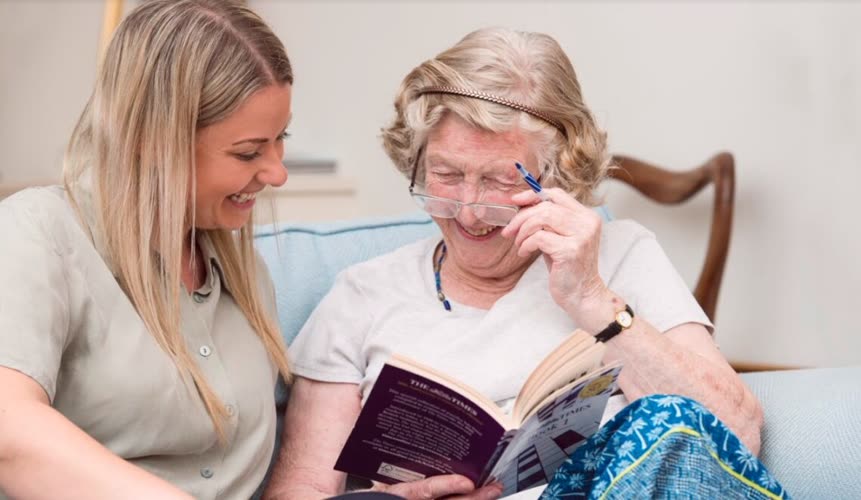
One carer who learns the specific deficits
No two brain injuries are alike. A consistent carer learns exactly which tasks need prompting, which need supervision, and which the person can still do alone.
✧ Our services
After a brain injury, recovery and daily life depend on routine, patience and consistency. A live-in brain injury carer supports rehabilitation, independence and safety at home, and helps the whole family adjust.

An acquired brain injury (ABI) is any injury to the brain that happens after birth, whether from a stroke, infection, lack of oxygen or a tumour. A traumatic brain injury (TBI) is caused by a blow to the head, for example in a road accident or a fall. The effects vary enormously: physical weakness and fatigue, problems with memory, concentration and planning, changes in personality, emotions and behaviour, and difficulty with communication.
Brain injury care at home supports a person with those effects in their own home, helping them rebuild skills, stay safe and take part in family and community life. Live-in care provides the consistent, around-the-clock presence that many people with a brain injury need.
Many people with a brain injury find change, noise and unfamiliar people overwhelming. Fatigue can arrive suddenly, and memory problems make new routines hard to learn. A single live-in carer who knows the person, their triggers and their strategies can keep the day predictable, which reduces stress and supports recovery far more than a rotating team of visiting carers.
Where there is a personal injury claim, a case manager often coordinates rehabilitation and support. We work with case managers, deputies and therapists to provide carers who fit the rehabilitation plan and report progress clearly. For people without a claim, we work with the community neuro-rehabilitation team, GP and family.
A brain injury changes a family as well as a person. Partners and parents often become carers overnight and may be coping with a relative whose personality has changed. Live-in care takes on the practical and physical load, gives family members space to rest and rebuild their relationship, and brings a calm, experienced presence into the home. Headway, the brain injury association, also offers support to families.
Live-in brain injury care starts from £1,300 a week. Care may be funded through a personal injury claim or interim payments, through the council after a needs assessment, through NHS Continuing Healthcare where needs are complex and health-related, or through PIP. Our guide to brain injury and personality changes covers care at home in more depth.
Some effects of a brain injury are obvious, such as weakness on one side or difficulty walking. Many are not. Families often find the hidden effects the hardest to live with:
These are symptoms of the injury, not choices. Understanding that is the first step to supporting someone well.
For many people with a brain injury, routine is not just helpful; it is part of recovery. A predictable day reduces the mental load of decision-making, making energy available for rehabilitation and enjoyment. Carers help build routines using visual timetables, checklists and phone reminders, and gradually hand responsibility back as the person becomes able to manage more. The goal is always the most independence possible, even if that means some tasks take longer.
People with brain injuries have the right to make their own decisions, including ones that others think unwise, unless they lack capacity for a particular decision. Carers support safe choices without being controlling: agreeing plans for cooking, money and going out, identifying vulnerabilities such as being taken advantage of, and involving the family or case manager where there are serious concerns. Where capacity is in question, decisions follow the Mental Capacity Act.
For many people, meaningful activity is a major part of recovery and wellbeing. With the right support, some people return to work, often gradually, while others find purpose through study, volunteering or new interests. A carer can help with travel, planning and managing fatigue during the day, working alongside vocational rehabilitation services and the person's employer where appropriate.
Sleep problems are very common after a brain injury, including difficulty falling asleep, waking in the night, or sleeping far more than before. Poor sleep worsens fatigue, memory, mood and behaviour, so it is worth taking seriously. A consistent routine, daylight and activity during the day, a calm environment in the evening, and avoiding caffeine and alcohol help. If problems persist, the GP or rehabilitation team can look for treatable causes. A carer supports the routine and keeps a record of sleep to share with professionals.
A brain injury can affect the skills needed to drive safely, such as concentration, reaction times, vision and judgement. In the UK, drivers must tell the DVLA about certain medical conditions, including many brain injuries, and must not drive until they are told it is safe. Rules vary depending on the injury, so it is important to check the DVLA's guidance and follow medical advice. While someone cannot drive, a carer can help with transport so they stay connected to their community.
Why families choose it
No two brain injuries are alike. A consistent carer learns exactly which tasks need prompting, which need supervision, and which the person can still do alone.
Seizure risk, poor balance or impaired judgement are managed by someone present in the home, catching problems before they become an A&E visit.
Memory loss, mood swings or reduced impulse control are met with the same calm, familiar response each time, rather than a different reaction from a different face.
Exercises and routines set by physiotherapy or occupational therapy are far more likely to be kept up daily with someone there to support them.
Handing over the physical and supervisory demands of care lets family members go back to being family, rather than exhausted round-the-clock carers.
Is it right for us?
If one of these sounds familiar, brain injury care at home is worth a conversation.
Hospitals often discharge sooner than families feel ready for. Live-in care can be arranged quickly to support that transition home.
Impulsivity, low frustration tolerance or confusion following the injury can be hard for a family alone to manage safely and calmly.
A new seizure risk or repeated falls usually mean someone needs to be present in the home at all times, not just checking in.
Progress often stalls when exercises and routines aren't kept up consistently between appointments — a live-in carer helps keep that going.
Round-the-clock supervision is physically and emotionally demanding. Bringing in a professional carer is often the only sustainable option.
What a carer does
Every care plan is built from these, weighted to whatever matters most in your household.
Personal care and daily routines adapted to the specific physical and cognitive effects of the injury.
A constant presence for seizure risk, balance problems or impulsive behaviour, reducing the risk of falls or accidents.
Patient, consistent responses to memory loss, confusion or mood changes from someone who knows the person's baseline.
Housework and errands taken care of, alongside steady support keeping up therapy exercises between appointments.
Related services
Live-in care is not one fixed thing. These are the variations families most often need — and we will tell you which one actually fits.
For people who need attention repeatedly through the night. Covers waking nights and, where nights are consistently broken, two carers in rotation.
A professional steps in so a family carer can rest, from a few days to several weeks. Also the easiest way to try live-in care before committing.
For a hospital discharge, a fall, or a carer suddenly unable to continue. We can often have someone in place within 24 to 48 hours.
Cover through the night only, where days are manageable but nights are not. Useful after a hospital stay or while a diagnosis settles.
Carers experienced in memory loss, sundowning and changes in behaviour. Familiar rooms and one consistent face matter more here than anywhere.
Comfort-focused support at home, working alongside district nurses and the GP so symptom control and dignity come first.
Support for the final months, weeks or days at home, for the person and for the family around them.
Where the need is company and daily structure rather than personal care. Often the first step, before anything more is required.
What you get
Being straight about the boundaries saves everyone a difficult conversation later.
Compared honestly
The three realistic options, side by side. We will tell you if one of the others suits you better.
| Live-in care | Residential care home | Visiting care | |
|---|---|---|---|
| Typical weekly cost, one person | From £1,200 | £1,100 – £1,600 | £300 – £900 |
| Typical weekly cost, a couple | From £1,200 (one carer) | £2,200 – £3,200 (two places) | Varies by hours |
| Staff-to-person ratio | One-to-one | Shared across residents | One-to-one, but only during visits |
| Same carer each day | Yes | No — shift rota | Rarely |
| Stay in your own home | Yes | No | Yes |
| Overnight cover | Yes | Yes | No — unless booked separately |
| Couples stay together | Yes | Often not possible | Yes |
| Pets can stay | Yes | Almost never | Yes |
| Visitors any time | Yes | Visiting hours | Yes |
Care home figures are typical UK ranges for 2026 and vary considerably by region and by whether nursing care is included. We quote our own prices exactly; always confirm a care home's fees directly with them.
Our carers
The single biggest worry families raise, and rightly. You choose the carer from matched profiles, and you can speak to them by video call before deciding anything.


Our carers
Our carers are spread across the UK, supported by regional care managers. Every one is interviewed in person, enhanced DBS checked and reference-checked before they are ever introduced to a family — and you choose who moves in.
 Gladys
Live-in carer
Gladys
Live-in carer
 Brenda
Live-in carer
Brenda
Live-in carer
 Patience
Live-in carer
Patience
Live-in carer
 Vistorine
Live-in carer
Vistorine
Live-in carer
 Refiloe
Live-in carer
Refiloe
Live-in carer
 Monica
Live-in carer
Monica
Live-in carer
How it works
A friendly, no-obligation call to understand the situation, explain how the care works and give you an estimated weekly cost.
We send profiles of available carers matched to your needs. You can speak to them on a video call before deciding.
Your carer moves in and support starts, with a named care manager checking in regularly to make sure it's working.
Free callback
Leave your number and a care manager will call you back — usually within an hour, and always free.
Or call us now on 0800 368 8558 Lines open 8am–10pm, seven days a week
Common questions
What families ask us before arranging care.
Not seeing your question?
Our care managers answer these every day. A no-obligation call takes about ten minutes.
0800 368 8558Lines open 8am–10pm, seven days a week See all questionsLive-in brain injury care starts from £1,300 a week as one fixed weekly fee. Two carers may be needed where there are significant night-time needs or behaviour that requires two people.
Yes. We work with case managers, deputies and solicitors to provide carers who fit the rehabilitation plan, with clear reporting on progress and hours.
Yes. We match carers with brain injury experience who follow the behaviour support plan agreed with the clinical team, and who stay calm and consistent.
Yes. Many people we support are younger adults who want to live at home, return to community life and, where possible, work. A care home is rarely the right setting for them.
Yes. Carers support the goals and exercises set by therapists and neuropsychologists, which helps skills carry over into real daily life between sessions.
ABI covers any brain injury after birth, including stroke, infection and lack of oxygen. TBI is a type of ABI caused by a blow or trauma to the head.
A predictable routine reduces the mental effort of planning and deciding, which helps with fatigue and memory problems. It also frees energy for rehabilitation and the activities that matter to the person.
Fatigue, memory problems, difficulty planning, emotional changes, reduced insight and sensory overload. These are often harder for families than physical effects, and are symptoms of the injury rather than choices.
Many can, often gradually. Carers help with travel, planning and managing fatigue, alongside vocational rehabilitation services and the employer. Others find purpose through study or volunteering.
By agreeing plans for risky activities, supporting the person to make their own choices, and involving family or the case manager where there are serious concerns, following the Mental Capacity Act where needed.
Transparent pricing
One weekly fee covering the agreed care plan. No hidden charges for everyday care.
Read next


Related care
There are two types of nervous systems, the central nervous system, and the peripheral nervous system. The central nervous system is composed of the brain and spinal cord, and the peripheral nervous system is composed of nerves that branch out of the spinal cord and extend to the other body parts.
A stroke happens when a blood vessel supplying the brain or an area of the brain is blocked and ruptures. Due to the unavailability of blood to the brain tissue, the cells begin to die. A stroke is a medical emergency. But patients, once recovered from the emergency situation, need constant care and attendance depending upon the severity of the symptoms.
Spinal cord injuries are very serious and can lead to a lifetime of lost independence. It is important for those who have suffered from a spinal injury to understand the appropriate ways to care for their injury in order to make it easier on themselves. It also might be essential to consider care at home. In this blog post, we will discuss how you can rehabilitate your injury at home or work so that you don't have as much trouble getting around and doing things independently!
The elderly population is rapidly growing as the baby boomers age. The senior population will soon surpass that of children and teens in size. This blog post discusses mental health care for elderly patients, which is very important to provide a quality life and avoid depression. If you don’t have the time, you should hire elderly live-in care for them.
Disability care is specialised home care designed to support individuals with physical, learning, sensory, or complex disabilities. This type of care focuses on assisting with daily activities, mobility, personal care, and emotional well-being while promoting independence and quality of life.
Near you
Local pages cover how care is regulated and funded where your relative lives.
Where we work
We arrange care in 850+ towns and cities. Choose your area for local pricing, funding and how care is regulated where you live.
Can’t see your area? Call 0800 368 8558 — we almost certainly still cover it.
Free, no-obligation call back
Answer 5 quick questions and one of our care managers will call you back to talk through the options and give you a clear weekly price.
Prefer to talk now? 0800 368 8558 Lines open 8am–10pm, seven days a week
One of our care managers will call you back shortly. If it's urgent, call us now on 0800 368 8558 .