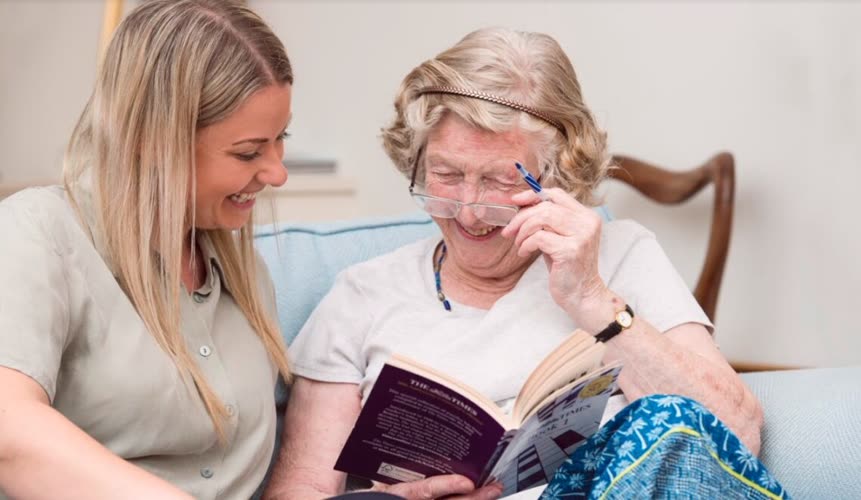
Someone there when visiting hours don't stretch far enough
Wards have restricted visiting times. A carer can sit with someone through the long stretches of the day when family simply can't be there.
✧ Our services
A hospital stay can be frightening and disorientating, especially for someone with dementia. We can arrange for a familiar carer to spend time at the bedside, help at mealtimes and with communication, and then support a safe return home.

When an older person goes into hospital, ward staff look after their medical care, but busy wards cannot provide one-to-one company. Many people, especially those with dementia, hearing or sight loss, or anxiety, struggle with unfamiliar surroundings, eating and drinking enough, and understanding what is happening. Some become more confused in hospital, which can lengthen their stay.
Care support during a hospital stay means a carer who knows the person spends time with them at the bedside, as agreed with the ward, and helps make the stay less frightening. It works especially well for people who already have a live-in carer, who can continue to visit while their client is in hospital.
Visiting arrangements are always agreed with the ward. Many hospitals welcome familiar carers, particularly under schemes such as John's Campaign, which supports the right of people with dementia to have their carers with them in hospital.
The most important part of hospital support is often the return home. Delays in discharge are frequently caused by waiting for care to be arranged. If a live-in carer is ready, your relative can often go home sooner. The carer can meet them from the ward, collect medication, make sure the home is warm and ready, and support them through the first days, which are when falls and readmissions are most likely. See emergency home care for urgent discharges.
Many people need extra support for a few weeks after a hospital stay while they regain strength. Short-term live-in care helps with personal care, mobility, meals and medication, and works alongside any reablement, district nursing or therapy support arranged by the hospital. Care can then reduce or end as independence returns.
Live-in care at home starts from £1,200 a week. After a hospital stay, the council may provide a short period of free reablement, and people with complex health needs may be assessed for NHS Continuing Healthcare. See our funding guide.
A hospital stay can have effects beyond the illness that caused it. Older people, and especially people with dementia, may experience:
A familiar face at the bedside can help with each of these, and ward staff often welcome the extra support.
Delirium is common in older people in hospital and can be frightening for families. It usually comes on over hours or days, with confusion that may come and go, agitation or drowsiness, and sometimes seeing things that are not there. It is different from dementia, although people with dementia are more likely to develop it. Delirium usually improves as the underlying cause is treated. Familiar people, glasses and hearing aids, clocks and calendars, good hydration and a calm environment all help. If you notice a sudden change in your relative's confusion, tell the ward staff straight away.
For planned admissions, some preparation helps: a bag with glasses, hearing aids, dentures, comfortable clothes and familiar items; a written summary of routines, medication, allergies and how the person communicates; a "This is me" document or hospital passport for people with dementia or learning disabilities; and a plan for care at home afterwards. Arranging live-in care for the return home before the admission avoids delays in discharge.
The first days after leaving hospital are often the riskiest. People may be weaker than before, taking new medication, and less confident on their feet. Having a live-in carer ready for discharge day means medication is collected and understood, meals and fluids are managed, and help is there at night. It also means problems, such as new confusion or pain, are noticed early and reported, which can help avoid a return to hospital.
When a relative is in hospital, getting clear information can be difficult, especially for families who live far away. It helps to agree one family contact for the ward, ask when the best time to call is, and keep a notebook of what staff say, including the names of doctors and nurses and any plans for tests or discharge. Asking early, "What needs to happen before Mum can go home?", often speeds things up. A carer who visits regularly can also relay information, with the patient's consent, and make sure the ward knows about the person's usual routine, communication and needs.
Hospital stays often lead to changes in medication: new medicines started, doses changed, or long-standing tablets stopped. Confusion about these changes is a common reason for problems after discharge. Before leaving, ask for a written list of all medicines and what has changed. At home, the carer checks the discharge letter against what is in the house, removes stopped medicines to avoid mix-ups, and contacts the GP or community pharmacist if anything is unclear. Many pharmacies also offer a free New Medicine Service or discharge medicines review.
After a hospital stay, some people are offered a short period of reablement: support, usually free for up to six weeks, to help them regain skills and confidence at home. Live-in care can work alongside reablement, providing support around the clock while the reablement team works on specific goals, and can continue once reablement ends if more help is still needed.
Why families choose it
Wards have restricted visiting times. A carer can sit with someone through the long stretches of the day when family simply can't be there.
A carer who knows the person well can help pass on preferences, concerns and history to busy ward staff, and flag anything family should know.
Unfamiliar surroundings can be disorientating, particularly for someone older or living with dementia. A familiar carer nearby helps keep them calmer.
The same carer who supported the hospital stay can go home with the person on discharge day, rather than a new face starting from scratch.
For relatives who live far away or can't take time off work, knowing someone trusted is with their family member matters enormously.
Is it right for us?
If one of these sounds familiar, hospital support at home is worth a conversation.
Work, distance or their own health can make it impossible for family to visit as often as they'd like.
A change of environment can unsettle someone who is already unwell, particularly if they live with dementia.
Hospitals often move quickly once someone is fit for discharge. Having care arranged in advance avoids a gap when they get home.
Distance shouldn't mean a relative is alone in hospital. A carer can be there in person when family can't.
A hospital admission doesn't mean the caring stops — it just moves location, and can still be exhausting without support.
What a carer does
Every care plan is built from these, weighted to whatever matters most in your household.
A familiar, reassuring presence through the long hours of a hospital stay when family can't always be there.
Passing on the patient's needs and preferences to busy ward staff, and keeping family informed of what's happening.
Calm, familiar company to ease the confusion and anxiety that unfamiliar hospital surroundings often bring.
The same carer continuing on discharge day, helping the transition back to a familiar home go smoothly.
Related services
Live-in care is not one fixed thing. These are the variations families most often need — and we will tell you which one actually fits.
For people who need attention repeatedly through the night. Covers waking nights and, where nights are consistently broken, two carers in rotation.
A professional steps in so a family carer can rest, from a few days to several weeks. Also the easiest way to try live-in care before committing.
For a hospital discharge, a fall, or a carer suddenly unable to continue. We can often have someone in place within 24 to 48 hours.
Cover through the night only, where days are manageable but nights are not. Useful after a hospital stay or while a diagnosis settles.
Carers experienced in memory loss, sundowning and changes in behaviour. Familiar rooms and one consistent face matter more here than anywhere.
Comfort-focused support at home, working alongside district nurses and the GP so symptom control and dignity come first.
Support for the final months, weeks or days at home, for the person and for the family around them.
Where the need is company and daily structure rather than personal care. Often the first step, before anything more is required.
What you get
Being straight about the boundaries saves everyone a difficult conversation later.
Compared honestly
The three realistic options, side by side. We will tell you if one of the others suits you better.
| Live-in care | Residential care home | Visiting care | |
|---|---|---|---|
| Typical weekly cost, one person | From £1,200 | £1,100 – £1,600 | £300 – £900 |
| Typical weekly cost, a couple | From £1,200 (one carer) | £2,200 – £3,200 (two places) | Varies by hours |
| Staff-to-person ratio | One-to-one | Shared across residents | One-to-one, but only during visits |
| Same carer each day | Yes | No — shift rota | Rarely |
| Stay in your own home | Yes | No | Yes |
| Overnight cover | Yes | Yes | No — unless booked separately |
| Couples stay together | Yes | Often not possible | Yes |
| Pets can stay | Yes | Almost never | Yes |
| Visitors any time | Yes | Visiting hours | Yes |
Care home figures are typical UK ranges for 2026 and vary considerably by region and by whether nursing care is included. We quote our own prices exactly; always confirm a care home's fees directly with them.
Our carers
The single biggest worry families raise, and rightly. You choose the carer from matched profiles, and you can speak to them by video call before deciding anything.

Our carers
Our carers are spread across the UK, supported by regional care managers. Every one is interviewed in person, enhanced DBS checked and reference-checked before they are ever introduced to a family — and you choose who moves in.
 Refiloe
Live-in carer
Refiloe
Live-in carer
 Brenda
Live-in carer
Brenda
Live-in carer
 Monica
Live-in carer
Monica
Live-in carer
 Gladys
Live-in carer
Gladys
Live-in carer
 Patience
Live-in carer
Patience
Live-in carer
 Vistorine
Live-in carer
Vistorine
Live-in carer
How it works
A friendly, no-obligation call to understand the situation, explain how the care works and give you an estimated weekly cost.
We send profiles of available carers matched to your needs. You can speak to them on a video call before deciding.
Your carer moves in and support starts, with a named care manager checking in regularly to make sure it's working.
Free callback
Leave your number and a care manager will call you back — usually within an hour, and always free.
Or call us now on 0800 368 8558 Lines open 8am–10pm, seven days a week
Common questions
What families ask us before arranging care.
Not seeing your question?
Our care managers answer these every day. A no-obligation call takes about ten minutes.
0800 368 8558Lines open 8am–10pm, seven days a week See all questionsA carer can spend time at the bedside as agreed with the ward. Many hospitals welcome familiar carers, especially for people with dementia, under schemes like John's Campaign.
Yes. We can usually have a live-in carer in place within 24 to 48 hours, ready to meet your relative from hospital and settle them at home.
Often it does. Discharges are frequently delayed while care is arranged, so telling the ward a live-in carer is ready can help your relative go home sooner.
Yes. Many families arrange live-in care for a few weeks after discharge while their relative regains strength and confidence.
Yes. Carers can bring glasses, hearing aids, dentures, clothes and familiar items, which make a big difference to comfort and communication.
Short-term reablement may be free after discharge, and people with complex health needs may qualify for NHS Continuing Healthcare. Otherwise it is usually arranged privately.
A sudden onset of confusion, often caused by illness, infection, medication or an unfamiliar environment. It is common in older people in hospital and usually improves as the cause is treated. Tell ward staff about any sudden change.
Glasses, hearing aids, dentures, comfortable clothes, familiar items, a medication list and a summary of routines and communication needs. A hospital passport helps for people with dementia or learning disabilities.
Days spent in bed lead to rapid muscle loss, especially in older people. Getting up and moving as much as it is safe to, and support at home afterwards, helps recovery.
Plan care at home early, ideally before a planned admission. Telling the ward that a live-in carer is ready can help your relative leave hospital as soon as they are medically fit.
Transparent pricing
One weekly fee covering the agreed care plan. No hidden charges for everyday care.
Read next


Related care
Our emergency live in care service provides one-to-one support at home from a trained, DBS-checked carer — matched to your family's needs, routine and personality.
Our respite care at home service provides one-to-one support at home from a trained, DBS-checked carer — matched to your family's needs, routine and personality.
Our dementia care at home service provides one-to-one support at home from a trained, DBS-checked carer — matched to your family's needs, routine and personality.
Knee and hip replacement surgery are an invasive procedure. The recovery time can take weeks to months, depending on the severity of the injury that necessitates it. Knee and hip replacement patients may need assistance with daily living tasks, including bathing, dressing, and cooking food. This can take a couple of weeks before the patient can start doing things for himself again. If you are working, you can hire live in care direct service to assist you during the day.
A stroke happens when a blood vessel supplying the brain or an area of the brain is blocked and ruptures. Due to the unavailability of blood to the brain tissue, the cells begin to die. A stroke is a medical emergency. But patients, once recovered from the emergency situation, need constant care and attendance depending upon the severity of the symptoms.
Near you
Local pages cover how care is regulated and funded where your relative lives.
Where we work
We arrange care in 850+ towns and cities. Choose your area for local pricing, funding and how care is regulated where you live.
Can’t see your area? Call 0800 368 8558 — we almost certainly still cover it.
Free, no-obligation call back
Answer 5 quick questions and one of our care managers will call you back to talk through the options and give you a clear weekly price.
Prefer to talk now? 0800 368 8558 Lines open 8am–10pm, seven days a week
One of our care managers will call you back shortly. If it's urgent, call us now on 0800 368 8558 .