Preventing Falls at Home: A Room-by-Room Checklist for Older People
Falls are one of the main reasons older people lose confidence and independence. According to the NHS, around 1 in 3 adults over 65 who live at home will have at least one fall a year, and about half of people over 80. Most falls happen at home, and many are preventable. This checklist walks through the home room by room, then covers the health checks that matter just as much as rugs and lighting.
Why falls matter so much in later life
Even a fall without a serious injury can knock someone’s confidence, and fear of falling leads many older people to move less. Moving less weakens muscles and balance, which makes the next fall more likely. Breaking that cycle is the aim: a safer home, a healthier body and a plan for what to do if a fall happens.
Hallways and stairs
- Fit sturdy handrails on both sides of the stairs, running the full length.
- Make sure stairs and landings are well lit, with switches at the top and bottom.
- Keep stairs completely clear: no piles of post, shoes or laundry “to take up later”.
- Mark the edge of each step with contrasting tape if eyesight is poor.
- Consider a second banister or a stair rail before a stairlift; an occupational therapist can advise.
Living room
- Remove or secure loose rugs and mats, which are a common cause of trips.
- Tidy trailing cables along walls or behind furniture.
- Arrange furniture so there is a clear route through the room.
- Choose a chair of the right height with arms to push up from.
- Keep the phone, remote control and glasses within easy reach.
Kitchen
- Store everyday items between waist and shoulder height to avoid stretching and bending.
- Wipe up spills straight away.
- Never stand on chairs; use a sturdy step with a handle, or ask someone else.
- A perching stool lets someone sit while preparing food.
Bathroom
The bathroom is where many falls happen, because surfaces are wet and people are getting in and out of baths and showers.
- Fit grab rails by the toilet, bath and shower.
- Use non-slip mats inside and outside the bath or shower.
- A raised toilet seat, bath board or shower seat makes transfers easier.
- Consider replacing a bath with a level-access shower; the council may help with the cost through a Disabled Facilities Grant.
Bedroom
- Put a lamp or switch within reach of the bed, and use night lights for the route to the toilet.
- Sit on the edge of the bed for a moment before standing, to avoid dizziness.
- Keep a commode by the bed if night-time trips to the toilet are risky.
- Make sure the bed is the right height to sit and stand easily.
Outside
- Keep paths and steps clear of leaves, moss and clutter.
- Fit outdoor lighting by the front and back doors.
- Add handrails to outside steps.
- In winter, grit icy paths and keep a supply of salt to hand. Our winter checklist for elderly parents covers cold-weather risks in more detail.
The health checks that matter as much as the home
A safer home helps, but most falls have health causes too. These checks are just as important:
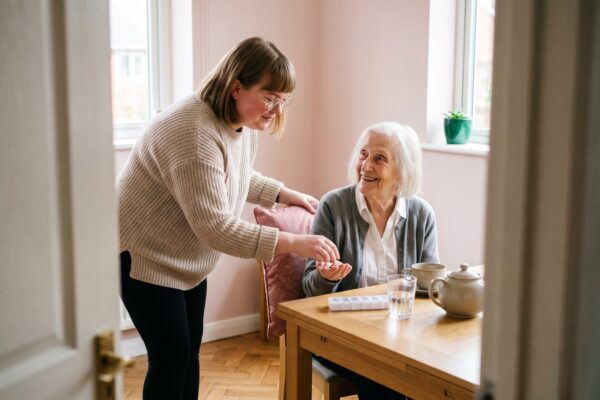
- Medicines review: some medicines cause dizziness or drowsiness, especially combinations. Ask the GP practice for a review. Our guide to managing medication safely explains how.
- Eyesight: NHS eye tests are free for people aged 60 and over in England. Update glasses, and take care with varifocals on stairs.
- Feet and footwear: well-fitting shoes or slippers with a back and a non-slip sole are far safer than loose slippers. A podiatrist can help with painful feet.
- Strength and balance: exercises that build leg strength and balance are proven to reduce falls. The NHS strength exercises are a good starting point, and the GP can refer to a local falls prevention service.
- Blood pressure on standing: a drop in blood pressure when standing up can cause dizziness and falls. Mention it to the GP.
- Continence: rushing to the toilet, especially at night, leads to falls. Treating the cause helps. See our guide to incontinence care at home.
Have a plan for if a fall happens
- A personal alarm or fall detector worn around the neck or wrist can summon help. Our article on predictive technology in care looks at newer options.
- Practise getting up safely from the floor with a physiotherapist, or learn how to stay warm and comfortable while waiting for help.
- Keep a phone within reach at floor level, for example a mobile in a pocket.
- Always tell the GP about a fall, even if there was no injury, as it may be a sign of an underlying problem.
When it is time for more help at home
If falls are becoming more frequent, or your parent is afraid to move around the house, it may be time for support. A live-in carer can help with getting up and about, steady someone on the stairs, keep the home clear and safe, and encourage the exercises that rebuild strength. You can read more about care for poor mobility and frailty and what a live-in carer does.
Live-in Care Direct is an introductory agency: we introduce families to experienced, self-employed live-in carers, and your care manager is your point of contact throughout. Get in touch to talk about your family’s situation.
Frequently asked questions
How common are falls in older people?
Very common. The NHS says around 1 in 3 adults over 65 living at home have at least one fall a year, rising to about half of people over 80.
What is the single most useful thing to prevent falls?
There is no single fix, but strength and balance exercises, a medicines review and removing trip hazards at home together make the biggest difference.
Should I tell the GP about a fall if my parent was not hurt?
Yes. A fall can be the first sign of a health problem such as an infection, a heart rhythm problem or a medicine side effect.
Tagged: Caring for Parents Elderly Care Falls Prevention